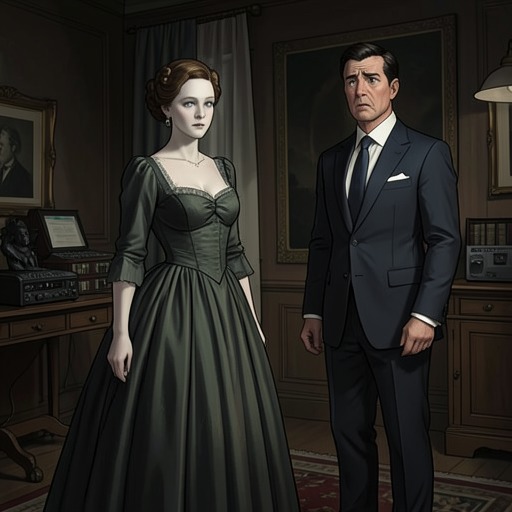
Kidnapping of Agnès and Vincent Dantier
Impure BloodThe kidnapping of Agnès and Vincent Dantier begins with two sudden absences and a repeated message: Agnès is snatched from the street, and Vincent is soon reported missing under the same threat. The abductions transform the investigation from concern for one endangered colleague into a crisis involving both members of the Dantier family, while placing Paul Darac in the position of receiving the evidence and directing the response.
The First Abduction
Agnès is already exhausted and overwrought when she walks back up a footway beside a ramp toward the avenue. The account gives her no warning that anyone is nearby: she does not notice the parked van or hear hurried footsteps behind her. As a telecom mast comes into view, a gloved hand clamps over her mouth. That is the last sensation she registers before losing consciousness. The abruptness leaves the abduction as a disappearance from her own point of view: there is no struggle described, no identification of the assailant, and no immediate explanation of where she has been taken.
The moment follows a passage in which Agnès has been thinking about Darac’s honesty and the professional pressure he faces. She has repeatedly defended his record to the Palais, and fears that a failure could cost him his position even though she believes his integrity would remain intact. Her admiration is personal as well as professional: she considers Darac the officer who comes closest to measuring up to her father. She has also recalled his unexpected tenderness in carefully massaging her hot, unwashed feet without fuss. The kidnapping therefore interrupts a scene of trust and care with sudden physical vulnerability; the contrast gives the attack particular force without establishing any link between her reflections and the kidnappers’ motives.
The Message at Agnès’s Home
The search reaches Agnès’s home, where Darac checks the kitchen and passes through the lounge into the dining room. Photographs there record the parallel careers of Agnès and her father, Vincent: an old image shows Vincent receiving his promotion certificate and dress uniform at the Caserne, while a companion photograph places Agnès at the center of a similar moment more than thirty years later. A picture of the two commissioners together is given pride of place. The domestic arrangement presents their shared professional history before the investigation discovers that both have been taken.
Frankie appears with her face ashen and tells Darac to look in the bedroom. He rushes in, bracing for the possibility of finding the body of someone close to him; instead, the room contains no corpse. On the pillow lies a sheet of A4 paper bearing a message assembled from cut-out newsprint. Darac’s police instinct is to pick it up, but he stops himself in time. The note makes the bedroom a crime scene and gives the disappearance a deliberate, communicative form. Its wording is not reproduced in the account, but the later report establishes that Vincent’s home contains the same message with the gendered wording altered.
Vincent’s Disappearance
Darac has already sent Granot and a six-person team to Vincent’s home on Avenue Célestine, a quiet cul-de-sac on the slopes of Mont Boron. Nearly half an hour later, Vincent has not answered either his home phone or his mobile. The delay leaves the investigation with a concrete but unresolved question: whether he is at home and unable to respond, or has disappeared as Agnès has.
When Darac’s mobile rings, Granot confirms the second abduction. Vincent has been taken, and the note left for him repeats the message found at Agnès’s home, substituting the masculine pronoun for the feminine one. The paired notes turn the separate absences into a coordinated action. The family photographs in the dining room, once a record of a father and daughter advancing through the police ranks, now sit against the fact that both commissioners are missing.
The Van and the Investigation
Granot’s report supplies a possible lead from the previous evening. An elderly neighbor, Eric Taglier, says he usually visits Vincent on Friday nights. The two men habitually walk down to the old port for a couple of slow cognacs and then take a taxi back. On this occasion, Taglier found no answer at Vincent’s house. More unusually, he saw a white, unmarked, long-wheelbase Mercedes panel van parked in the drive while the house appeared quiet and nobody came to the door.
The van sighting is a suspicious circumstance, not proof of who abducted Vincent or how either kidnapping was carried out. Together with the two matching notes and the failure to reach Vincent by either phone, however, it gives the investigation a specific line to pursue. The account thus moves from Agnès’s disorienting loss of consciousness to the procedural accumulation of signs: an untouched-looking home, a warning on a pillow, a second matching message, unanswered calls, and a vehicle remembered by a regular visitor.
Significance of the Paired Abductions
The two kidnappings are connected most clearly by their mirrored evidence. Each victim is associated with a home bearing the same cut-out message, adjusted only for gender, and Vincent’s disappearance is confirmed while Darac is directing inquiries into Agnès’s. The pattern makes clear that the threat concerns both father and daughter, rather than a single isolated attack. It also sharply changes the stakes for Darac: he must respond not only as the officer coordinating the search but as someone who knows Agnès well and has just been confronted with the prospect of finding her dead.
The opening account withholds the abductors’ identities, their destination, and their demands. Its tension comes instead from the gap between intimate knowledge and missing information. Agnès’s trust in Darac, the family’s visible history of service, and the familiar routine of Vincent’s Friday evenings all establish human and domestic detail; the kidnappers’ repeated, cut-paper message converts that ordinary setting into evidence of a planned crime. The van remains a lead, the notes remain a threat, and both Dantiers remain unaccounted for in this portion of the narrative.